

Ask to see the connector drawer in our workshop and you will understand why people write to us confused. Furutech makes dozens of plugs, spades, bananas, RCAs and XLRs, and the model codes read like part numbers from an aircraft catalogue. Behind the codes there is a simple structure: three families called FP, FT and CF, two plating choices that genuinely matter, and a damping material called NCF that does something real. This is the map we sketch on the counter when a customer is speccing a custom build, because in a hand made cable the connectors are not decoration. They are half of what you are paying for.
The three families: FP, FT and CF
FP is the foundation series, and it is already a long way from the hardware store. FP connectors carry Furutech's Alpha treatment, a two stage process of deep cryogenic stress relief followed by demagnetisation, applied to copper alloy contacts plated in gold or rhodium. The FP-203 spade and the FP-202(R) banana are the classics of the line: honest, precisely machined, and the sensible default on a mid priced cable. The FP-200B exists for the other end of the problem entirely, the spring clip terminals on older amplifiers, where a slim pin is the only thing that fits.
FT is the enthusiast tier. The bodies get heavier, the machining finer, and NCF starts appearing in the range: the FT-866-NCF(R) binding posts we fit when a customer is building or upgrading speakers use it in the insulating body. The FT-211 spades and FT-212 bananas are the speaker terminations we reach for when a cable has outgrown the FP grade but the budget stops short of the flagship.
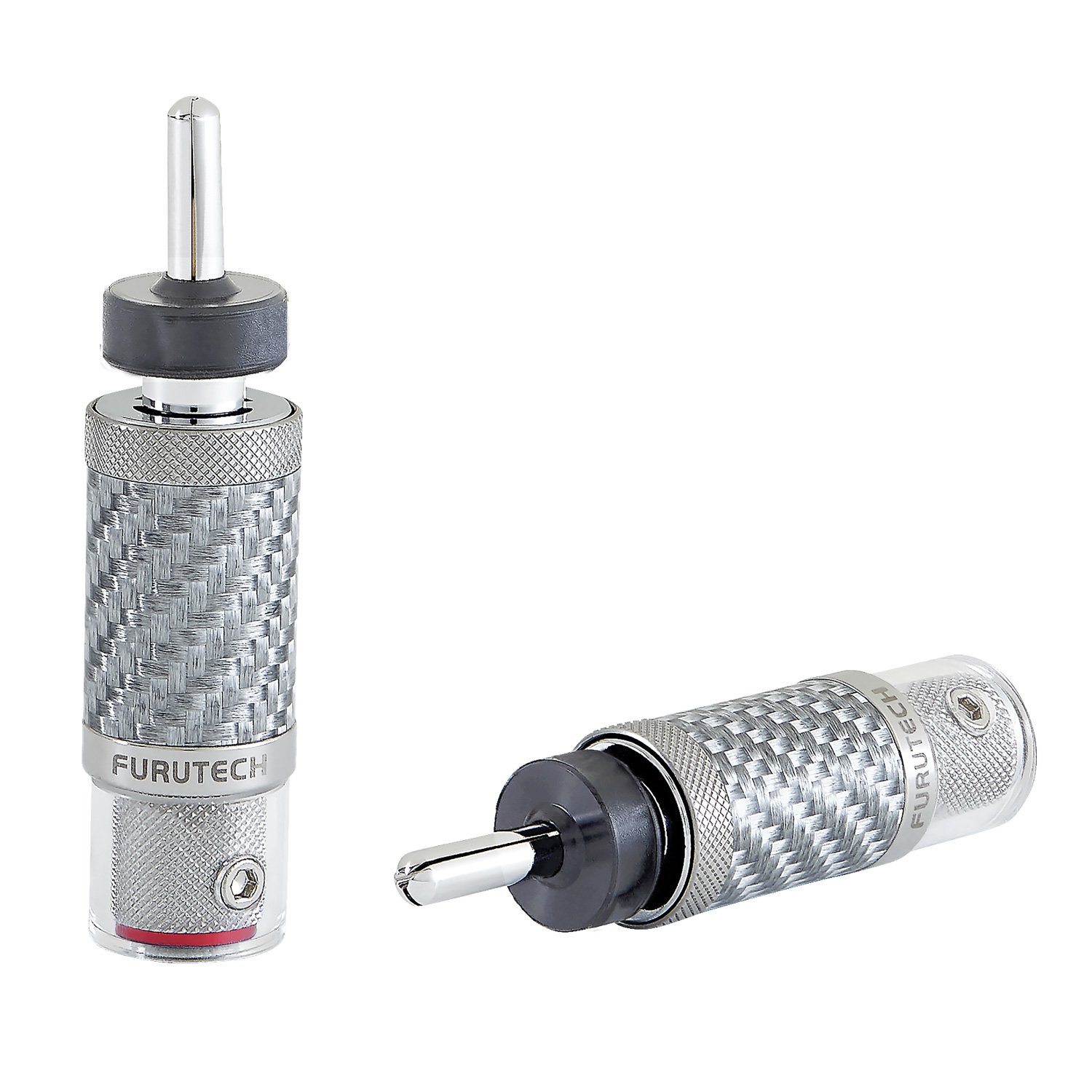
CF is the flagship line, and the differences are material rather than cosmetic. The conductors are pure copper rather than brass or phosphor bronze, the plating is rhodium, and the housings are built from NCF composite. On the speaker side the newest designs carry the NCF-Plus suffix, a revised formulation of the material: the CF-201-NCF-Plus(R) spades and CF-202-NCF-Plus(R) bananas are the finest terminations Furutech makes. On the signal side, the CF-102-NCF(R) RCA and the CF-601M-NCF(R) XLR bring the same recipe to interconnects. Handle one and the density tells you most of the story before you hear a note.
What NCF actually does
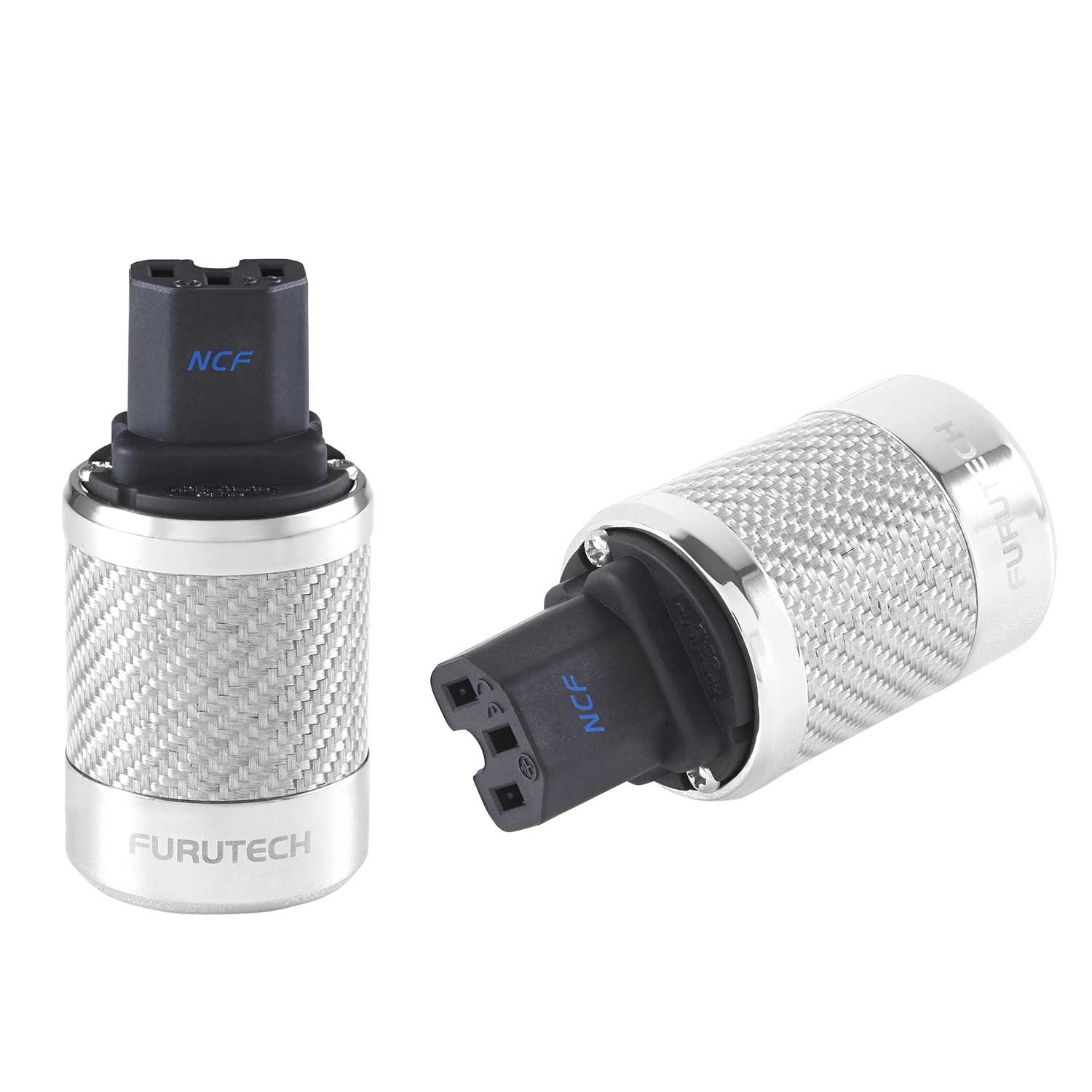
NCF stands for Nano Crystal Formula, a proprietary resin loaded with nano sized crystalline particles, and Furutech makes two specific claims for it. First, the material generates negative ions that neutralise static charge, and static is a genuine nuisance in a connector: it attracts dust into the joint and builds on insulating bodies in dry, air conditioned rooms. Second, the crystals exhibit piezoelectric behaviour, converting mechanical vibration and thermal energy into far infrared radiation, which is a way of saying the connector body dissipates resonance rather than storing it and feeding it back into the contact.
We were sceptical until we had lived with enough of it. Terminate the same wire into an NCF body and a standard one, and on a resolving system the difference shows up as a quieter backdrop and a small easing of hardness at the top end, the sort of change you notice most when you switch back. It is a refinement rather than a transformation, and we say so across the counter. For the full story, including the floating field damper in the flagship power connectors, our FI-50 NCF review goes deep, and the FI-11 review covers the affordable IEC end of the same family tree.
Rhodium versus gold
Both platings protect the copper beneath, and their characters differ. Gold never corrodes and reads slightly warm in a system, but it is soft, and a connector that gets swapped weekly will eventually wear through to the base metal. Rhodium is harder than any other plating in common use, effectively immune to tarnish through a humid Sydney summer, and good for decades of insertions. It measures a touch less conductive than silver or gold, but the layer is microns thin and the current rides in the copper underneath. Rhodium over pure copper is the combination the workshop standardised on years ago, and every listening comparison since has kept it there. A few power parts also come unplated, bare copper directly against the inlet, for the purists who accept the polishing routine that choice implies.
Why the connector matters in a custom build
A cable is only ever as good as its joints. The connector decides the contact area, the clamping force on the conductor, the strain relief on the jacket, and whether the whole assembly still grips firmly after a decade behind a warm amplifier. Match matters too: a heavy 15mm power cable hanging off a connector rated for thin flex will loosen its own clamp, while a slim interconnect screwed into an oversized barrel never seats properly. This is why a custom build starts with questions about your equipment rather than a price list. On mains leads, Australian systems also need a proper AS/NZS 3112 wall plug, and the FI-50AU-NCF(R) is the flagship answer, pure copper and NCF in a plug made for our sockets.
Our recommendation
Speccing a build: FP grade connectors on a modest cable, FT once the wire gets serious, CF when the rest of the system is resolving enough to show you what the flagship hardware does, and rhodium plating unless you already know you prefer gold. The full range we stock, from single bananas to NCF binding posts, lives in our accessories category. Tell us the amplifier, the speakers and the cable you have in mind on the custom order form and we will spec the ends to match, then terminate and test the finished cable on the bench before it ships.